• Skip to main content

New England Public Radio

  • Donate
  • National Public Radio
  • Public Radio International
  • Facebook
  • Twitter
  • Instagram

Karen Brown

Young Man Walks Across America to Listen, Reflect, Understand

by: Karen Brown

Five years ago, at 23, Andrew Forsthoefel decided to walk 4,000 miles across America with a handmade sign that said “Walking to Listen.” Along the way, he recorded dozens of stories from the people he met.

Now settled in Western Massachusetts, Forsthoefel has a new book about his journey.


Andrew Forsthoefel lives above a beer supply shop on a busy commercial strip in Northampton, so we walked to a bike path, where we had a few quiet miles to chat.

This is familiar terrain for Forsthoefel — walking and talking. It’s how he spent 11 months wandering from Chadds Ford, Pennsylvania — where he waved goodbye to his worried mother and set off on the railroad tracks — all the way to Half Moon Bay, California.
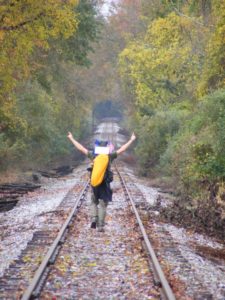
Andrew Forsthoefel on the first day of his cross-country hike – in a photo by his mother, Therese Jornlin.

“Before I walked across the country, walking was something I had done in sort of fits and starts, little hiking trips,” he said. “And then when I committed to a long-distance through-hike, walking became both my lover and my enemy. It became my teacher. It became a meditation, and it was miserable too! I don’t want to romanticize how miserable the experience was.”

When he started, Forsthoefel was a recent graduate of Middlebury College in Vermont, still grieving his parents’ divorce and looking for wisdom to guide him into adulthood.

He’d hoped to travel to a small village in Africa, but he lost a well-paying job and needed a cheaper adventure. That’s when he decided to fill a backpack with outdoor gear, a flip-phone, a mandolin and three books of poetry.

With $4,000 in savings, he planned to camp when necessary, accept a free couch when offered and record people’s stories.

“What sort of began to happen was that the walking primed me for connection with people,” he said. “All the hours I spent alone walking, sort of put me in this state of — well, basically — loneliness. I was just damn lonely out there, you know. To meet someone at the end of a day was just a miraculous thing to experience. Because there was no guarantee that I’d be with anyone that night. Maybe I was going to be under a bridge alone again.”

Forsthoefel followed a few self-imposed rules. He wouldn’t accept any ride that would shorten the trip. He would use only paper maps — no internet or GPS. And he wouldn’t listen to recorded music or podcasts.

“I wanted to be approachable. I wanted people to feel they wouldn’t be interrupting me, if they stopped and said something,” he said. “So I chose not to wear ear buds.”

That also helped him focus on self-reflection and random observations.

“I’d be walking along and I’d see a little strand of spider silk floating by, and just be mesmerized,” he said. “I would hear sounds I wouldn’t have heard otherwise. I’d feel things in my body I wouldn’t have felt otherwise. So it all became a pretty entertaining spectacle.”

He kept mostly to a southern route. Halfway through the trip, he bought a used babystroller to help haul his stuff, which must have been quite an image, he conceded, especially during the occasional bout of crying along the lonely highway.

He ate deep fried squirrel, got lost in the desert, and sang Amazing Grace with an old woman in Alabama.

He met many people outside the bubble of his middle-class youth: a trucker, prison guard, astrologer, Christian missionary, ceremonial dancer, retired bounty hunter, among others. He said they were often colorful, generous and contradictory.

“There was one woman and her husband who took me in to their home, took me out to dinner at Applebee’s or something. We had a great interview that night, cooked me breakfast in the morning,” he recalled. “And just as I’m heading out, she said, ‘You should think twice about walking through this town coming up ahead. All the whites left and the help stayed, and the Southern black is a whole different animal than the Northern black.'”

Forsthoefel said that kind of bigotry tended to shock him into silence, and he regrets not engaging people more in a discussion of their beliefs, and his. He said that’s one reason he wrote the book — to link the different perspectives he came across.

“I wished so many times that people I’d been with just the day before, who were warning me about people in the next town over, I wished they could be with me that night when I went to that town and got to meet some of these people and actually listen to them,” he said.

He emphasized that not only Southern conservatives could use a wider lens on the world, which is why he hopes his own example inspires future extreme-walkers.

“It would humble the most bleeding-heart liberal,” he said. “It would have the potential to complicate things for them in a way that’s very important, I think. Sort of erase the notion that anything is black and white. — including a Trump supporter. A Trump supporter is more than a Trump supporter. What else are they?”

Today, at 28, Forsthoefel is a full-time writer and public speaker. After a spiritual awakening on his big hike, he studies Buddhism and meditates.

If he were to take another cross-country listening walk, he said, he’d do it with other people.

Andrew Forsthoefel dedicated his book, “Walking To Listen,” to his mother.

Note: Thanks to Transom.org for interview clips from Forsthoefel’s journey, used in the broadcast version of this story. You can listen to Forsthoefel’s 2013 audio documentary about his trip.
After Months Of Debate Over ‘Indians,’ New Mascot Coming To Turners Falls

by: Karen Brown

Turners Falls High school will be getting a new mascot, now that the Gill-Montague School Committee — following months of contentiousness — has voted to abolish the longtime “Indians” name from school sports teams.

The Tuesday night vote was 6 to 3, after the superintendent argued that using the Indian as a mascot perpetuates stereotypes and presents a mixed message over civil rights.

Committee member Marjorie Levenson said she’d gone back and forth on the issue, but she did her own historical research on Indian imagery.

Also, “I think I received 150 to 200 emails from various members and individuals from Indian tribes or Native Americans,” she said.

Levenson said diversity is more valued in today’s schools than it was in the early 20th century, when the mascot was introduced.

“One of my best friends says, ‘Well, I loved the mascot; It made me very happy to be a cheerleader.’ And I understand that,” Levenson said. “But if it makes a member of a Native American tribe feel it hurts them and it’s degrading to them, then I have to say to myself, ‘I guess morality or ethics prevail.'”

Some defenders of the Indian mascot have said it honors local Native American history.

School Committee chairman Mike Langknecht was among those voting against the mascot change, though he said he was mostly voting against the process. He said the committee had not finished debating the issue with full community participation, and while various stakeholders may have the chance to weigh-in on the next mascot, “one of those alternatives will not be the Indians — the Turners Falls Indians.”

Langknecht said the committee did agree to let emotions settle for a while. That means avoiding any discussion of a new mascot for at least two more public meetings.

Other schools in the area still use Native American images and mascots, including the Taconic Braves in Pittsfield; the Indians in Ware and North Brookfield; and the Red Raiders in Athol and Springfield.

America’s Blood Economy: Vulnerable To Economic Trends, Medical Advances

by: Karen Brown

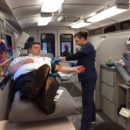
Most days, somewhere in New England, the American Red Cross and other blood banks put out the call for donations — and volunteers offer up their veins for the public good.

At a recent blood drive outside a yarn store in Northampton, Massachusetts, donors paraded in and out of a Red Cross Bloodmobile at a slow but steady space.

As one regular held gauze over his punctured arm, the nurse told him he was free to leave. “Make sure you feel OK,” she said. “Would you like a water?”

“Juice, maybe,” he replied.

A Drop In Demand

These donors don’t get paid for their blood. But while the raw product is free, the process around collecting and distributing the blood is not.

Hospitals pay blood banks for components — like plasma and red blood cells — and blood banks use that income to stay viable, even when donations are down.

But over the past decade, medical advances have had unintended consequences on this delicate balance.

“Every year, we’re seeing less total components transfused,” said Darlene Cloutier, lab director at Baystate Medical Center in Springfield, Massachusetts.

Doctors have learned to perform common surgeries with minimal blood loss, so they rely less on transfusions. Cloutier said that’s allowed them to avoid the risk — albeit low — of exposing someone to another person’s blood. And she said outcomes have improved.

“The patients that were transfused fewer units typically have lower lengths of stay and better recovery,” she said.

This also means hospitals buy less blood from the Red Cross and other private blood banks. Cloutier said Baystate uses about two-thirds as much blood today as it did five years ago, with some coming from its own, in-house donation program.

UMass Amherst business professor Anna Nagurney, who studies the blood supply, said this is typical across the country.

“The demand has gone down,” Nagurney said. “So that’s a huge issue because various blood service organizations now. They have to reduce their prices.”

‘A Very Urgent Situation’

That may be good for hospitals, which are under pressure to cut costs, but it’s not so good for blood banks. Nagurney said nationwide, between 2008 and 2014, blood bank revenue fell from about $5 billion to $1.5 billion.

“We believe this creates a very urgent situation,” said Ziggy Szczepiorkowski, president of the American Association of Blood Banks.

He said a drop in blood bank revenue has led to staff layoffs, less money for research and development and less  private investment in innovation or infrastructure.

“If you don’t have money to replace your equipment, your equipment is getting older and older,” he said. “So on a very basic level, you start to see older equipment, which is going to fail more frequently.”

An Unusual Commodity

Many blood banks have merged or consolidated, which may help with short term budgets, but Szczepiorkowski said it doesn’t get at the root of the problem — namely, a payment structure that allows blood to be treated like any other commodity.

“Under normal circumstances, you would think that blood industry would sort itself out, as a market force,” he said. “We don’t believe it’s going to happen without exposing our society to potential very high risks.”

For one, you can’t stock up on blood. It’s perishable. It lasts on a shelf between 5 and 42 days, so it’s tricky to collect just enough to fulfill the orders from hospitals, but not so much that it gets wasted.

And with the downsizing of the industry, Anna Nagurney of UMass worries that, if there’s a sudden demand for blood — say, a natural disaster or terrorist attack — blood banks won’t have the capacity to collect it in a hurry.

Plus, new viruses like Zika both reduce the supply of safe blood and raise the cost of testing it.

Looking For a Blood Safety Net

“Then you get times of great need, for example, like the holiday season,” Nagurney said. “And it’s really challenging, especially now in the winter season, because if you have a cold or flu, you’re not supposed to be donating blood. So that also decreases the supply.”

As a solution, Nagurney would like the blood bank industry to be more deliberate about its mergers and downsizing. Her own research looks at ways to make the blood supply chain more efficient.

“If they were able to, say, cooperate — right now they tend to compete with one another — then there could be some really good synergies,” she said. “We could have supply matching demand better.”

Last year, a Rand Corporation study confirmed the flux and uncertainty in the blood economy, recommending more  investment by the U.S. Department of Health and Human Services, to create a sort of blood safety net.

Abortion Rights Rally Organizers Frustrated By City Hall Process

by: Karen Brown

Organizers of a reproductive rights rally in Springfield this Saturday said the city has made it difficult for them to get permission.

They said city hall staff told them they need 21 days to apply for a rally permit, so organizers contacted ACLU Lawyer Bill Newman. He said that’s unconstitutional.

“The government is not supposed to be in the business of censorship,” Newman said. “And when the city of Springfield says we can censor free speech for at least three weeks, that’s not the law, it’s not the constitutional doctrine.”

In a statement, Mayor Dominic Sarno said he was not trying to stifle free speech but rather to ensure public safety. Sarno wrote that he instructed the city’s licensing attorney, Alysia Days, and Police Commissioner John Barbieri to work with the group.

In an email, Days said the group will be given a permit.

Millennial Magnum PIs: Recent College Grads Become Private Investigators

by: Karen Brown

Entering the job market out of college can be fraught – and require some creative gumption.

Consider Andrew: a friendly, lanky 23-year-old who graduated from Elms College last May.

Andrew has been my neighbor for more than a decade. He was the kind, older kid at the bus stop when my own children were in kindergarten. So when I ran into him last fall, I had to wrap my ahead around the new job he’d taken.

Andrew is a private eye – well, officially, “private investigator,” but who can resist a little noir embellishment?

In keeping with the mystique, I agreed not to use his last name, since his boss, who holds the PI license, didn’t know he invited me on a recent stakeout.

‘I Watched Too Many Spy Movies When I Was A Kid”

After he picked me up in his SUV, Andrew showed me a blurry photo of the night’s target. “He’s pretty tall, we can’t really miss him, he’s six-five.”

We proceeded to drive around Springfield, hoping to find and follow a man who claimed he hurt his lower back at his job. Andrew’s company was hired to confirm the man is actually injured – and if not, to get photographic proof for the insurer.

We start at the man’s official home address.

“There’s clearly nobody there,” Andrew said. “There’s no lights on. The driveway is not even shoveled.”

Andrew studied sports management in college, but couldn’t find a related job. He drove an Uber for a few months, until he learned several classmates had started working as private investigators. Training was quick, it paid $15 an hour plus expenses. And it sounded fun.

“I watched too many spy movies when I was a kid,” said Andrew. He remembers thinking to himself, “‘This is so cool. I can be like James Bond.'”

‘They Don’t Want To Sit At A Desk All Day’

Andrew is not alone. Private investigation used to be the domain of grizzled, retired cops looking to stay busy in their twilight years, but industry leaders say more and more millennials are discovering the field.

“They don’t want to sit at a desk all day,” said Bill Connors, president of Licensed Private Detectives Association of Massachusetts. Connors, who runs a PI firm south of Boston, said he’s one of about 850 licensed private investigators in the state.

Connors said he seeks out young people for his company, now that more colleges have launched professional tracks in private investigation. He said twenty-somethings bring new ideas and a familiarity with social media that many old-timers don’t have.

“The one guy I’m thinking of is like, ‘Oh, that’s just too complicated for me,'” Connors said. “Well, some of your best investigative leads and information come from Facebook or a tweet or whatever.”

Andrew still does a lot of classic gumshoe work, though, including long surveillance shifts like this one. He’s got trail mix in the car, a “change of clothes, hats, a toothbrush, toothpaste and floss.”

And he’s wearing slippers to be more comfortable. “I mean, I have shoes if I need [them],” he said.

‘I Do A Lot Of Crosswords’

Most of Andrew’s work is insurance fraud; the cheating spouse beat is reserved for more senior investigators, he said, since those cases can get heated.

By that point, our stakeout was pretty tame. We moved on to a banquet hall where Andrew was told his mark might be attending an office party.

As we drove around the parking lot, he stopped in front of a silver car that matched the description and license plate of his target. “I’m sure he’s somewhere inside,” Andrew said.

After checking that there is only one way to get out of the parking lot, he decided to park behind another car. None of the guests seemed to notice us. So we waited.

And waited.

For hours.

“I do a lot of crosswords,” Andrew said.

To speed things along, Andrew considered posing as someone looking for his grandfather at the party — another reason young PIs can be an asset.

When You Catch Your Target, ‘Everyone’s Happy — Except For Them’

“One thing this business needs is younger people to work undercover,” said former police detective Roger Torgerson, president of the U.S. Association of Professional Investigators.

“If you looked at me, one of the first things you would think of is: either you’re a police officer or you used to be one,” Torgerson said, pointing out there’s a certain look that can give away the veteran PI.

“There’s a lot of times you need to overhear conversations and get into meetings and things like that,” he said. “And you need those people that, when you look at them, the last thing in the world you think of is, they’re an investigator and working undercover.”

Andrew said he’s managed to stay undetected following people into movies, playing mini-golf and working out at the gym. When he’s lucky, he said, “you catch someone doing something they’re not supposed to do and you did a good job. And everyone’s happy — except for them.”

This was not one of those cases. By 10 p.m., everyone appeared to have left the party, but the target’s car was still in the parking lot.

We eventually gave up, and the next day, Andrew was on a new case. He’s still sending his resume to sports management companies – but for now, he’s enjoying his role as a millennial Magnum PI.

Springfield Rally Joins Nationwide Effort to Resist Trump’s Cabinet Nominees

by: Karen Brown

About 80 people showed up at the Springfield offices of Massachusetts U.S. Senators Elizabeth Warren and Ed Markey to thank them for at least trying to resist the cabinet nominees of President Donald Trump and to urge all fellow Democrats to do the same.

Victoria Kaplan is with the activist group Move On, which organized local rallies across the country. At the Springfield one, she started by leading the group in a chant — though, since many were new to activism, they had to be taught the words.

“OK,  let’s try that again,” Kaplan said, after one false start. “When working people are under attack, what do we do? Stand up, fight back!”

One participant, Anne Sweeney of Holden, Massachusetts, was holding a sign thanking Warren and Markey for “fighting the good fight.”

“I am just a citizen. I am fed up with the new president and his attitude and his policies,” Sweeney said. “And this is my first political event, and I’m proud to be here.”

Other participants spoke about their fear that Trump’s cabinet will try to gut the very departments they’ve been nominated to lead, and expressed concerns for the environment, health care, women’s rights and public education.

Staffers for Warren and Markey, who themselves were in Washington, invited the group into their building, promised to follow their constituents’ lead when it comes to resisting the Trump agenda and urged them to stay in touch throughout the next four years.

  • Go to page 1
  • Go to page 2
  • Go to page 3
  • Interim pages omitted …
  • Go to page 51
  • Older›
  • Listen Online
  • HD Radio
  • Mobile, iPhone & Android
  • Reception FAQs
  • Five College Consortium
  • Springfield Central Cultural District
  • National Public Radio
  • Public Radio International
  • University of Massachusetts
  • Amherst College
  • Mount Holyoke College
  • Smith College
  • Hampshire College
  • Five Colleges Incorporated
  • Springfield Central Cultural District

© 2026 New England Public Radio